

What if the extra five kilometers in your morning drive actually saved you fifteen minutes of frustration? We’ve all felt that familiar tightening in the chest when approaching Hessa Street at 7:30 am, wondering if the school run will derail your entire morning. When weighing the Tilal Al Ghaf vs Dubai Hills Estate commute, it’s easy to assume that being geographically closer to the city center automatically translates to a smoother journey. However, the 2026 landscape tells a much more nuanced story of infrastructure, timing, and strategic exits.
You deserve a home that respects your professional schedule and your family’s peace of mind. We understand the pressure of balancing a career in the city with a desire for a resort-style sanctuary. This guide offers you a clear, data-driven look at real-world travel times following the completion of the Hessa Street widening to four lanes and the Al Khail Road enhancements. We will explore how these 2026 road improvements have shifted the map, helping you choose a community that offers genuine connectivity, lasting value, and a rhythm of life that truly fits your needs.
Key Takeaways
- Discover why the geographic center of Dubai is shifting and how this changes the perception of distance when choosing your next home.
- Evaluate the impact of the completed Hessa Street widening project on the Tilal Al Ghaf vs Dubai Hills Estate commute and morning travel times.
- Compare real-time 2026 data for journeys to Business Bay, Dubai Marina, and Al Maktoum International Airport to find your ideal professional fit.
- Learn how to select specific sub-communities like Elan or Harmony based on their strategic proximity to major road exits and local shortcuts.
- Understand the relationship between 2026 infrastructure improvements and the long-term rental yields of these two premier master-planned estates.
Navigating Dubai in 2026: Why the Commute Defines Your Community Choice
Dubai’s map has transformed. By 2026, the city’s “center of gravity” has moved decidedly toward the south and west, driven by the massive expansion of the Dubai South corridor and the maturation of inland masterplans. This shift makes the Tilal Al Ghaf vs Dubai Hills Estate commute a question of strategy rather than just distance. If you’ve lived in Dubai for any length of time, you know that kilometers are a deceptive metric. A ten-kilometer drive on a clear highway is far more pleasant than a three-kilometer crawl through a congested neighborhood. We believe your home should be a place of rest, not a source of transit anxiety.
Choosing between these two iconic communities means choosing between two distinct philosophies. Dubai Hills Estate represents urban centrality, placing you in the heart of the action with immediate access to the Al Khail Road and the sprawling Dubai Hills Mall. Tilal Al Ghaf, conversely, champions resort connectivity. It offers a sanctuary that feels miles away from the urban bustle, a hub for family growth, and a strategic anchor for the future. The 2026 infrastructure projects have effectively bridged the gap, making the “too far out” anxiety a relic of the past.
The Evolution of Dubai Commute Patterns
Business Bay and Downtown remain vital hubs, but the rapid expansion of Dubai South and the Al Maktoum International Airport corridor has fundamentally changed how traffic flows across the emirate. Peak-hour patterns have evolved as hybrid work models become the standard for residents in luxury communities. Instead of focusing on being in the geographic center, savvy homeowners now prioritize “exit ease.” They look for neighborhoods with multiple, efficient routes to the E311 and E611, ensuring they aren’t trapped by a single bottleneck. This shift has made the Tilal Al Ghaf vs Dubai Hills Estate commute a more balanced comparison than it was just a few years ago, as the city’s infrastructure catches up to its visionary growth.
Commute as a Lifestyle Factor
Your morning drive is more than just time spent in a car; it’s the bridge between your home sanctuary and your professional goals. For many families, the “commute” is actually the school run. Having the Royal Grammar School Guildford Dubai (RGS) right on your doorstep within Tilal Al Ghaf can eliminate morning stress entirely. A deep understanding of Dubai’s transport system is essential for long-term resident satisfaction. At TAG Property, we act as your community-led lifestyle concierge, providing real-time insights that go beyond simple GPS estimates. We help you understand which sub-communities, such as the townhouses in Elan or the sprawling villas in Harmony, offer the most seamless start to your day based on their specific exit points and local traffic flow.
The Tilal Al Ghaf Connectivity Map: Life Beyond Hessa Street
For years, the mere mention of Hessa Street evoked a sense of hesitation for prospective residents. In 2026, that narrative has fundamentally changed. The Tilal Al Ghaf vs Dubai Hills Estate commute is no longer defined by a single bottleneck but by a sophisticated network of multi-lane highways and strategic bypasses. Have you considered how a few minutes of extra distance can be traded for a significantly more peaceful start to your morning? This community was designed for those who value efficiency, comfort, and foresight in their daily movements.
The Hessa Street Transformation
The RTA’s Hessa Street Development Project reached its full completion in January 2026, widening the road to four lanes in each direction. This massive undertaking has fundamentally shifted the rhythm of the neighborhood. Travel times from Tilal Al Ghaf to Sheikh Zayed Road (E11) have stabilized, with the increased capacity absorbing the morning rush far more effectively than in previous years. Recent RTA road connection projects have further integrated these residential areas into the city’s wider grid, ensuring that your journey feels like a steady glide rather than a frustrating crawl. While peak hours still require a bit of planning, the off-peak flow is now remarkably fluid, offering a seamless connection to the city’s coastal hubs.
Alternative Routes and Backroads
One of the hidden strengths of Tilal Al Ghaf is its multi-directional accessibility. While Hessa Street is the primary artery, residents frequently utilize Al Fay Road as a vital bypass to Jumeirah Village Circle and Sports City. This route provides a clear path toward the Expo 2020 site and the burgeoning professional hubs in Dubai South. If you are looking for a home that offers more than just one way out, consulting a Tilal Al Ghaf real estate agent can provide you with neighborhood-specific shortcuts that only a local expert would know. These “resident-only” insights are what make the daily drive feel shorter and more intuitive.
The long-term mobility of the area is anchored by the tilal al ghaf master plan, which future-proofs the community against urban growth. It isn’t just about the roads outside the gates; it’s about the internal flow. For instance, the townhouses in Elan are positioned for rapid exit toward the E311, while the Harmony villas offer a more scenic, internal route that avoids early-morning congestion. This careful planning ensures that every resident, regardless of their sub-community, enjoys a sense of freedom and ease. If you would like to see how these exit points could work for your specific schedule, our team at TAG Property is here to guide your discovery.
Dubai Hills Estate: The Perks and Pitfalls of Central Living
Dubai Hills Estate has long been the gold standard for central, urban living. Its position within the “Golden Quadrant” offers a lifestyle that feels connected to the very pulse of the city. For many, the appeal lies in being minutes away from the Dubai Hills Mall or a short drive from the glittering skyline of Downtown. However, when evaluating the Tilal Al Ghaf vs Dubai Hills Estate commute, it’s essential to look beneath the surface of geographic proximity. While you are physically closer to the city’s core, the density of a fully matured masterplan brings its own set of daily considerations.
Living in a community of this scale means accepting a trade-off. You gain immediate access to world-class amenities and healthcare, but you also inhabit a high-density environment. The “hustle and bustle” that makes the area vibrant can also lead to a more frantic morning rhythm. We believe that a true luxury lifestyle should offer a sense of ease from the moment you leave your driveway, a factor that is becoming increasingly important to modern Dubai residents.
Al Khail Road Dynamics
Al Khail Road (E44) is the lifeblood of the community. It provides a direct artery to the city’s commercial hubs, but it also acts as a significant bottleneck during peak hours. By 2026, the volume of traffic visiting the Dubai Hills Mall has created a new dynamic for residential exits. On a clear day, the drive to Dubai Marina might take 15 minutes, but during peak evening hours, this can easily stretch to 33 minutes. The convenience of living in a major commercial destination means sharing your local roads with thousands of visitors, a trade-off that requires careful thought when planning your professional schedule.
Internal DHE Traffic Challenges
The “School Run” effect is perhaps the most significant daily hurdle for DHE residents. With prestigious institutions like GEMS and Brighton College located within the community, internal roads can become heavily congested between 7:30 am and 8:30 am. Navigating out of sectors like Maple or Sidra often involves a series of roundabouts that slow your progress before you even reach the main highway. This internal density is a stark contrast to the resort-style layout of newer communities. It’s one reason why families seeking a more rhythmic, predictable morning are increasingly exploring tilal al ghaf harmony for a calmer exit and a more relaxed start to the day. While DHE offers the excitement of a high-density urban hub, the Tilal Al Ghaf vs Dubai Hills Estate commute comparison often highlights the value of a community designed with modern traffic flow as a priority.
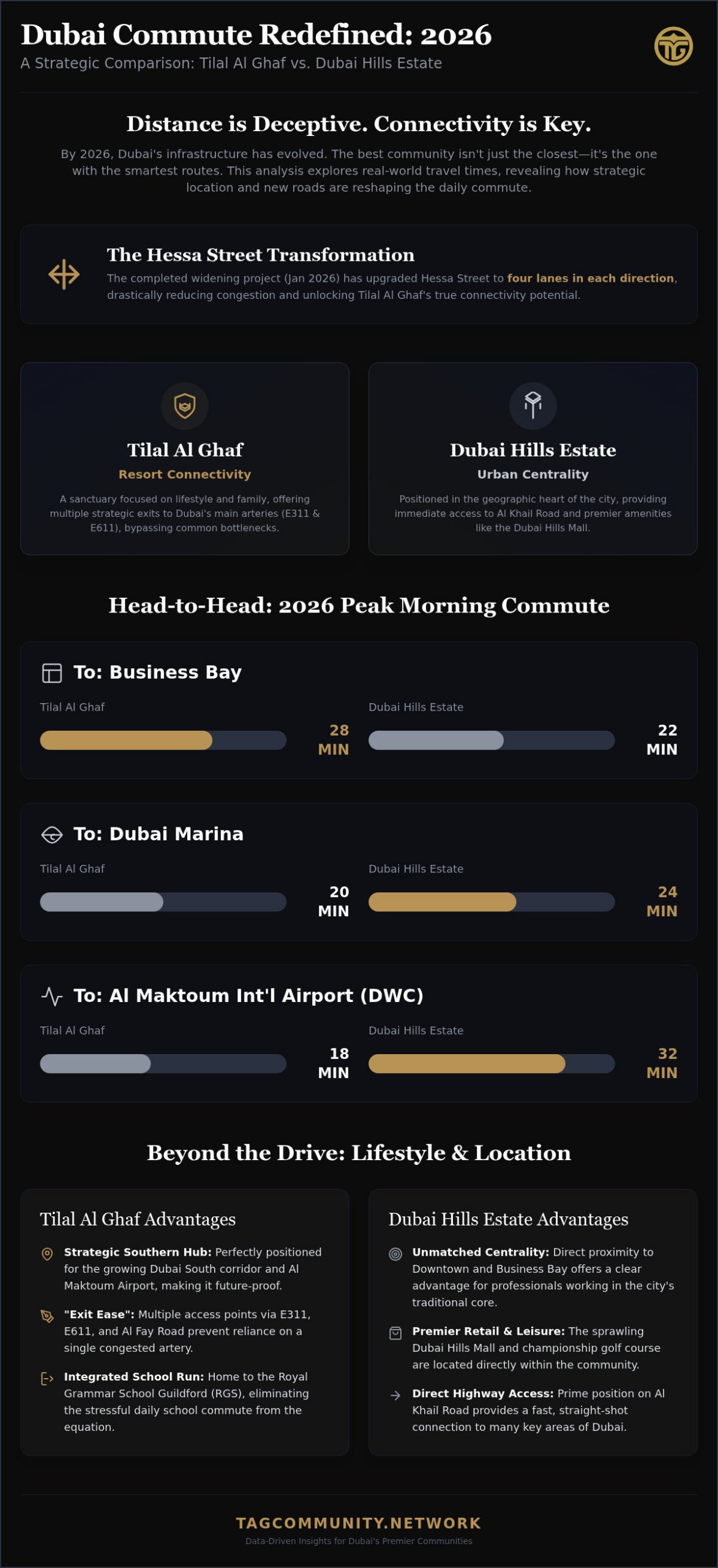
Head-to-Head: 2026 Commute Times to Dubai Business Hubs
Does the “15-minute city” truly exist in Dubai, or is it a clever marketing aspiration? For a resident in 2026, the answer depends entirely on your daily destination. We believe that true luxury is found in the time you save, the stress you avoid, and the predictability of your schedule. When we look at the Tilal Al Ghaf vs Dubai Hills Estate commute, the data suggests that “centrality” is a relative term. Depending on whether your office is in the traditional North or the burgeoning South, your experience behind the wheel will vary significantly.
The Corporate Commute: DIFC and Business Bay
For those anchored in the city’s financial heart, Dubai Hills Estate maintains a clear geographic advantage. Utilizing the high-capacity Al Khail Road, a resident can typically reach DIFC in 15 to 20 minutes during the 8:00 am rush. In contrast, the journey from Tilal Al Ghaf involves navigating the Hessa Street corridor or the E311, resulting in a commute of approximately 25 to 30 minutes. While the 2026 widening of Hessa Street has smoothed this route, the extra ten minutes is a consistent factor. For a DIFC lawyer or a Business Bay banker, the five-day-a-week journey from Dubai Hills Estate offers a more compact and efficient start to the professional day.
The Tech and Media Commute: Marina, JLT, and Internet City
This is where the narrative shifts in favor of the South. Tilal Al Ghaf residents benefit from a direct line down the newly optimized Hessa Street, reaching Dubai Marina or Jumeirah Lake Towers in a remarkable 18 to 22 minutes. Dubai Hills Estate residents, while physically closer on a map, must often navigate the Umm Suqeim bypass or face the heavy density of Al Khail’s southern exits, often resulting in a 20 to 25-minute journey. Because Tilal Al Ghaf is positioned to feed directly into these coastal hubs without the “inner-city” congestion of more established masterplans, it has become the preferred anchor for professionals in the tech and media sectors.
The Airport Test: DXB vs. DWC
Travel patterns in 2026 are increasingly split between Dubai’s two aviation hubs. Dubai Hills Estate remains the superior choice for frequent flyers using DXB, with a typical transit time of 20 minutes. However, as more international operations shift to Al Maktoum International (DWC), Tilal Al Ghaf has emerged as a strategic powerhouse. Reaching DWC from the lagoon-side villas takes roughly 20 to 25 minutes, whereas the drive from Dubai Hills can stretch well beyond 35 minutes during peak hours. If your lifestyle involves global connectivity, understanding these transit times is vital for your long-term comfort. To explore how these travel times impact property values in specific sub-communities, contact our expert advisors for a personalized consultation.
Ultimately, both communities offer a version of the 15-minute city, but for different lifestyles. Dubai Hills Estate places a world-class mall and a championship golf course within a few minutes’ drive. Tilal Al Ghaf counters with the ability to walk from your front door to a crystal lagoon, while still maintaining a rhythmic connection to the city’s newest economic engines. It’s not about which community is closer to the center; it’s about which community is closer to your center.
Beyond the Drive: Choosing Your Community Based on Your Hub
The journey home is more than a sequence of turns and traffic lights. It’s the essential transition from your professional ambitions to your personal sanctuary. While we’ve dissected the technical data of the Tilal Al Ghaf vs Dubai Hills Estate commute, the final decision often rests on how you want your day to end. Do you see yourself pulling into the high-energy environment of a metropolitan mall, or do you prefer the quiet anticipation of a sunset stroll by the lagoon? Your choice reflects a commitment to your family’s peace of mind, your personal wellness, and your long-term lifestyle goals.
In 2026, the ease of access has become a primary driver of property value. Investors are no longer looking just at square footage; they’re analyzing “exit ease” and “return comfort.” A community that offers a predictable, stress-free journey home will always command higher rental yields and stronger resale interest. We believe that Tilal Al Ghaf provides a unique advantage here, offering a resort-style retreat that feels worlds away from the city, yet remains strategically tethered to Dubai’s most vital hubs.
The School Run Factor
For many families, the most important “commute” happens before 8:00 am within the community gates. The school run is a major differentiator between these two estates. In Dubai Hills Estate, the concentration of multiple high-profile schools often leads to internal car-based congestion. Conversely, Tilal Al Ghaf was designed with a focus on walkability and buggy-friendly paths. Residents in sub-communities like Elan or Harmony enjoy a distinct proximity advantage to the Royal Grammar School Guildford Dubai (RGS). Being able to walk your children to a world-class school doesn’t just save time; it fosters a sense of connection, health, and community that is rare in a fast-paced city. This internal flow is a significant factor in property desirability, ensuring that your investment remains resilient as the city grows.
Final Verdict: TAG or DHE?
Choosing your winner depends on your professional rhythm. If your career requires a physical presence in DIFC or Downtown five days a week, the urban centrality of Dubai Hills Estate is a compelling argument. It’s the logical choice for the daily office warrior who values being at the center of the action. However, for the hybrid worker, the entrepreneur, or the professional anchored in the South and Marina hubs, the Tilal Al Ghaf vs Dubai Hills Estate commute comparison leans heavily toward the lagoon. The “resort living” feel of Tilal Al Ghaf provides a superior environment for those who spend more time at home, offering a calm, restorative atmosphere that DHE’s high-density layout can’t quite match.
You aren’t just buying a villa; you’re choosing how you spend your most precious resource: time. If you’re ready to embrace a lifestyle where the return home is as beautiful as the destination, you should learn how to buy property in Tilal Al Ghaf through our specialized 2026 guide. Our team at TAG Property acts as your community architect and lifestyle concierge, helping you navigate the nuances of each sub-community to find the perfect fit for your schedule and your soul. Let’s find the home that makes every journey worth the drive.
Mapping Your Future: Finding the Perfect Rhythm for Your Dubai Life
Choosing between these two prestigious estates isn’t just about kilometers; it’s about aligning your daily journey with your long-term goals. We’ve seen how the 2026 infrastructure updates have transformed the Tilal Al Ghaf vs Dubai Hills Estate commute, turning what was once a distance debate into a strategic lifestyle choice. Whether you prioritize the urban energy of Dubai Hills or the resort-style serenity of Tilal Al Ghaf, the right home should offer you more than just a roof. It should provide a genuine sense of harmony and ease.
As award-winning Tilal Al Ghaf specialists, we understand the nuances of this evolving landscape. Our community-led digital concierge services provide you with real-time resident insights that go beyond any map. We offer expert guidance on the 2027 Masterplan to ensure your investment grows alongside the city’s ambition. Find your perfect Tilal Al Ghaf home with TAG Property and let us help you navigate your next chapter with confidence. You deserve a home that fits your schedule and your soul.
Frequently Asked Questions
Is Hessa Street still congested in 2026?
Traffic flow has improved significantly following the completion of the RTA widening project in January 2026. While peak hours still see a high volume of vehicles, the expansion to four lanes in each direction has eliminated the severe bottlenecks of previous years. You’ll find that the journey is now far more predictable, allowing for a much smoother start to your morning routine.
How long does it take to get from Tilal Al Ghaf to Dubai Mall?
You can typically expect a drive of approximately 25 to 30 minutes during the morning rush. This route generally utilizes Hessa Street to connect with the E311 or Al Khail Road. While it’s slightly longer than the journey from more central communities, the stabilized traffic patterns in 2026 make this a manageable and reliable commute for most professionals.
Which community is closer to the Dubai Hills Mall?
Dubai Hills Estate is the clear winner here as the mall is located directly within the heart of the masterplan. For DHE residents, the mall is often just a three to five-minute drive or a short walk away. If you’re living in Tilal Al Ghaf, you can reach this retail hub in roughly 15 to 20 minutes via Umm Suqeim Street.
What is the best route from Tilal Al Ghaf to the Marina?
The most efficient path is taking Hessa Street directly toward the coast. This route has become the preferred choice for residents since the 2026 road improvements were finalized. It typically takes between 18 and 22 minutes to reach the heart of Dubai Marina or JLT, making it an excellent option for those working in the city’s southern tech hubs.
Are there public transport options for Tilal Al Ghaf vs Dubai Hills?
Dubai Hills Estate currently offers more established connectivity with dedicated RTA bus routes and easier access to the wider city grid. While the Tilal Al Ghaf vs Dubai Hills Estate commute is still primarily car-dependent, TAG residents can utilize the RTA on-demand bus service for a flat fare of AED 5. Neither community has a dedicated Metro station as of August 2026.
How does the commute from Tilal Al Ghaf compare to Arabian Ranches?
The experience is quite similar, but Tilal Al Ghaf often offers better “exit ease” toward the newer parts of Dubai. Because it’s a more modern development, the internal road network was designed to handle 2026 traffic volumes more effectively than the older phases of the Ranches. You’ll likely find the internal flow at TAG to be more rhythmic and less congested.
Will the 2027 Masterplan improve Tilal Al Ghaf connectivity further?
Yes, the upcoming phases of the 2027 Masterplan focus heavily on enhancing internal mobility and creating even more seamless links to the Emirates Road (E611). These future updates are specifically designed to ensure that as the community matures, your ease of movement remains a top priority. We believe these strategic improvements will continue to drive long-term value for homeowners.
Is Dubai Hills Estate better for people working in DIFC?
It is generally the more efficient choice for those anchored in the financial district. With a typical commute time of 15 to 20 minutes via Al Khail Road, it saves you roughly ten minutes each way compared to the journey from Tilal Al Ghaf. If your professional life centers on the city’s northern corporate hubs, DHE’s urban centrality provides a clear time-saving advantage.